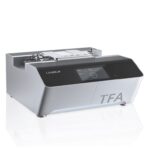
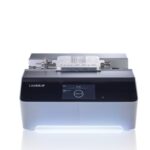
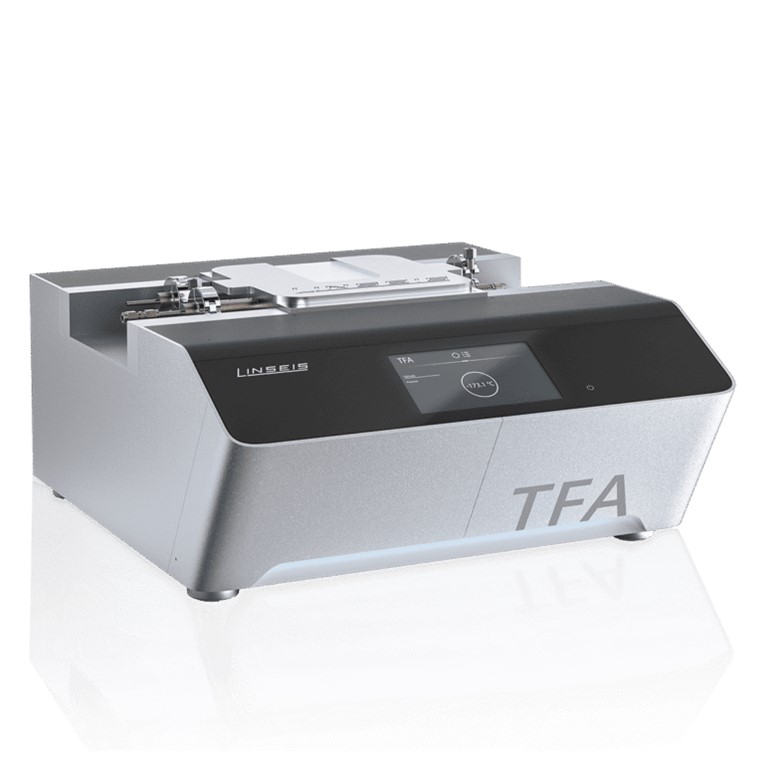
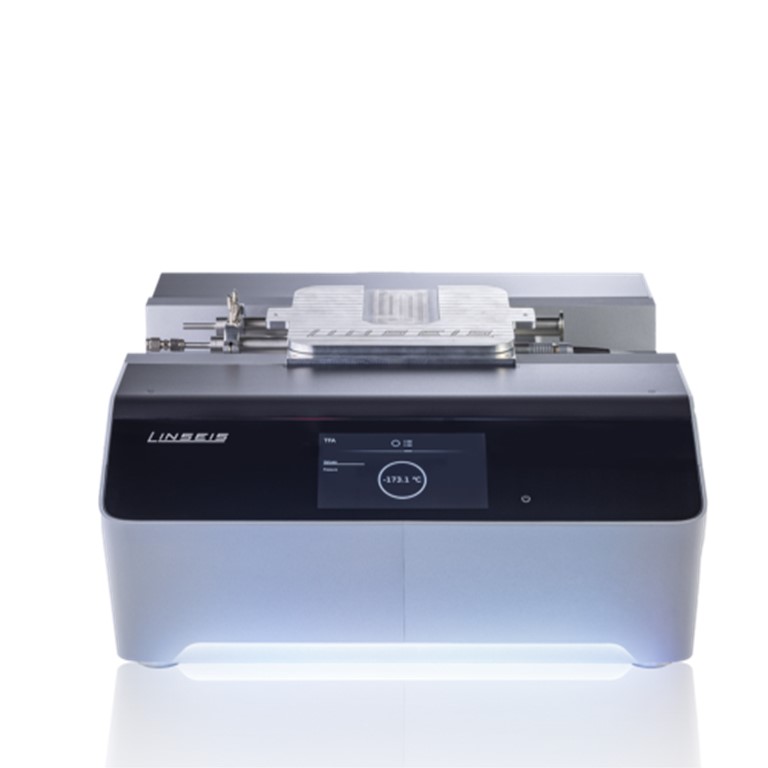
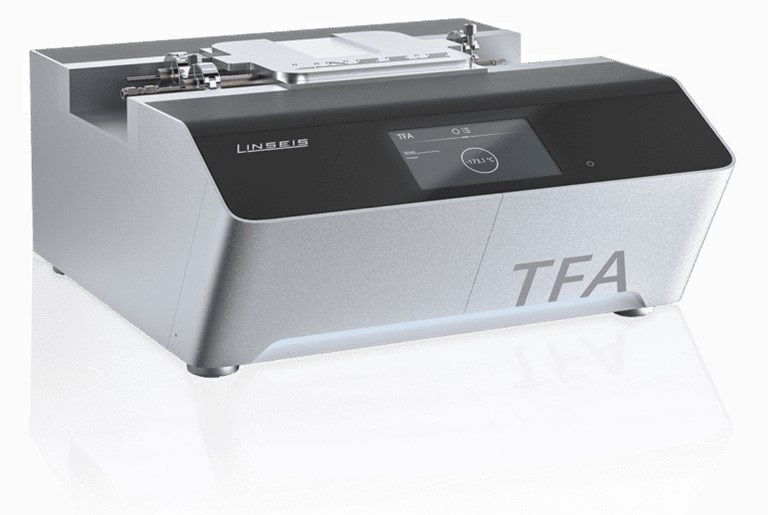
TFA L59thin film analyzer for precise, reliable characterization of the physical properties of thin films using an integrated, easy-to-use measurement platform.
Determination of the physical properties of thin films
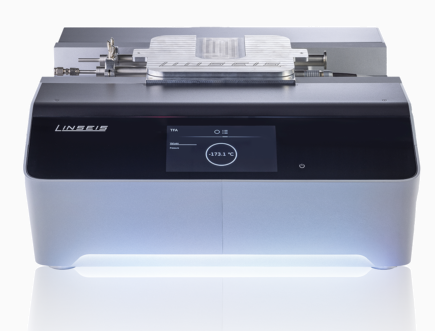
The newLINSEIS TFA L59 device offers the characterization of physical properties of thin films. It is a highly integrated, easy-to-use measurement platform designed for precise and reliable thin film analysis.
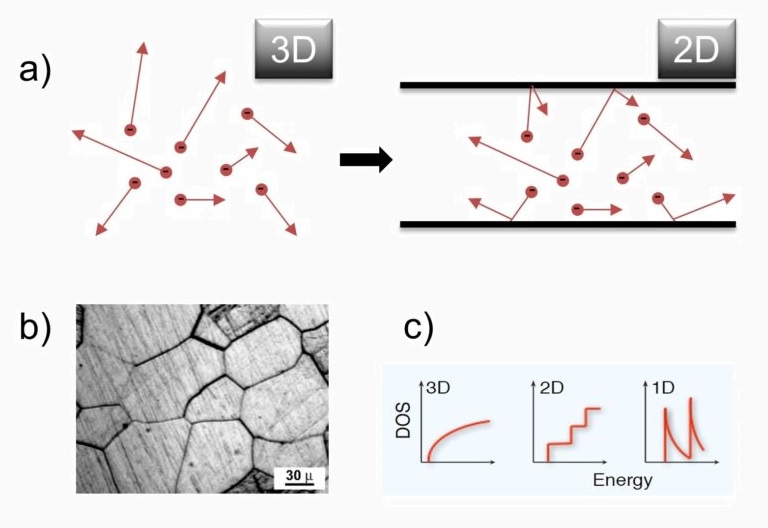
Physical properties of thin films differ from bulk materials, as parasitic surface effects become significantly stronger due to reduced dimensions and high aspect ratios.
☑️ Increasing influence of surface scattering (a) ☑️ Additional boundary scattering (b) ☑️ Quantum confinement effects in ultra-thin layers (c)
The LINSEIS Thin Film Analyzer is an ideal tool for precise, reliable characterization of a wide range of thin film samples in an extremelyfast and comfortable way. It is an easy-to-use, stand-alone system delivering high-quality results using a patent-pending measurement design.
Components of the TFA
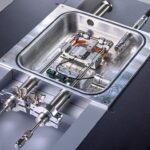
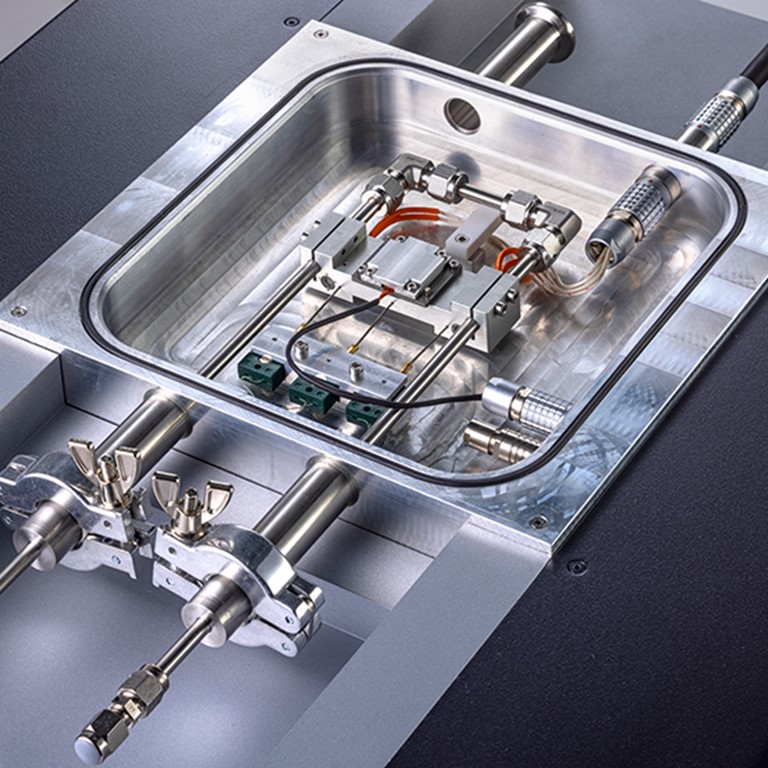
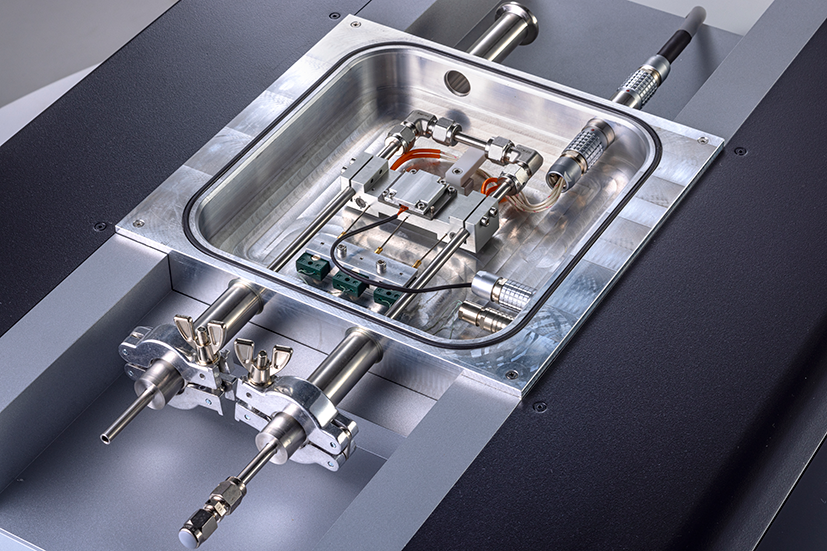
The basic setup consists of a measurement chip on which the sample can be easily deposited, and a measurement chamber providing the required environmental conditions. Depending on the application, the system can be operated with a Lock-In amplifier and/or a high-power electric magnet to enable precise signal detection.
Measurements are typically performed under UHV conditions, while the sample temperature can be accurately controlled between -160°C and 280°C using LN2-based cooling and powerful heating systems, ensuring stable, reliable, and reproducible measurement conditions.
Pre structured measuring chips
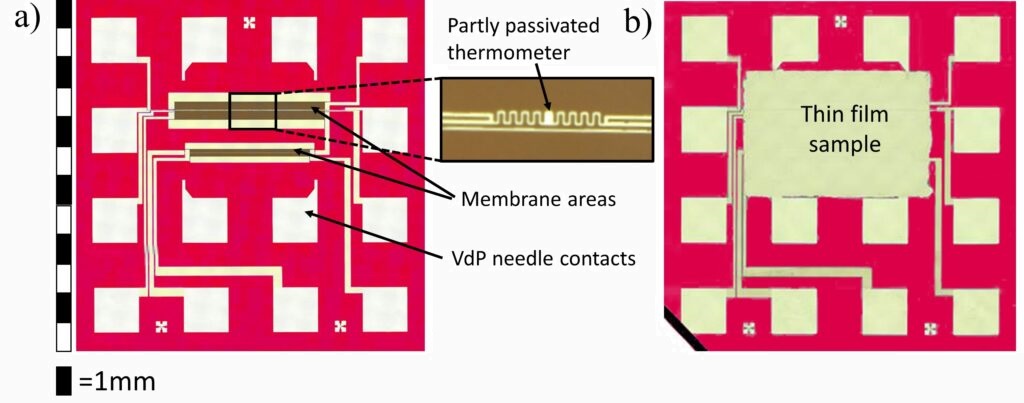
The chip combines the 3ω measurement technique for thermal conductivity determination with a 4-point Van-der-Pauw setup for the evaluation of electrical transport properties.
The Seebeck coefficient can be measured using additional resistance thermometers located near the Van-der-Pauw electrodes. For easy sample preparation, either a strip-off foil mask or a metal shadow mask can be used.
This configuration enables a nearly simultaneous characterization of a sample prepared by PVD (e.g. thermal evaporation, sputtering, MBE), CVD (e.g. ALD), spin coating, drop casting, or ink-jet printing in a single measurement step.
The big advantage of this system is the simultaneous determination of a broad range of physical properties within one measurement run. All measurements are taken in the same (in-plane) direction and are therefore highly comparable.
1. Van-der-Pauw measurement
To determine the electrical conductivity (σ) and Hall coefficient (Aᴴ) of the sample, the Van-der-Pauw method is used. After depositing the sample on the chip, it is already connected to four electrodes A, B, C & D at its edge.
For the measurement, a current is applied between two contacts while the corresponding voltage is measured across the remaining two. By systematically changing the contact configuration in a clockwise sequence and repeating the procedure, the resistivity of the sample can be calculated using the Van-der-Pauw equation. By applying a magnetic field and measuring the resulting change in the diagonal Van-der-Pauw resistance, the Hall coefficient of the sample can be determined.
2. Seebeck Coefficient measurement
For the determination of the Seebeck coefficient, an additional thermometer and heater are placed on the chip near the sample. This configuration enables the measurement of the thermovoltage at different temperature gradients, which is then used to calculate the Seebeck coefficient according to S = −Vth/ΔT.
3. Thin film thermal conductivity measurement
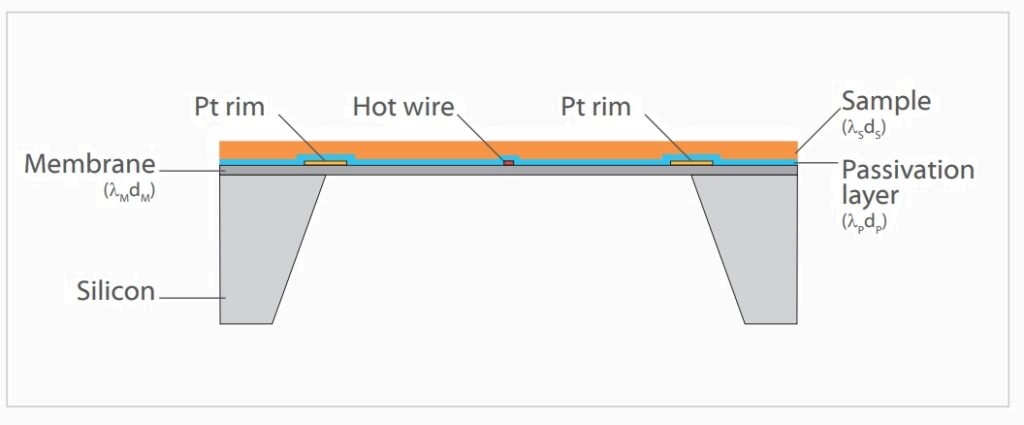
For the determination of the in-plane thermal conductivity, a patent-pending hot-stripe suspended membrane setup is used. In this configuration, a very small wire acts as both heater and temperature sensor. The sample is deposited directly onto this membrane for measurement.
A current is applied to the hot wire, which is heated by Joule heating. Due to the resulting temperature increase, the resistivity of the wire changes and can be measured directly.
From this resistivity change and the known geometry of the setup, the thermal conductivity of the sample can be calculated. Depending on the material, it is also possible to determine the specific heat capacity. For high-quality results, the product of sample thickness and thermal conductivity should be equal to or greater than 2 × 10⁻⁷ W/m·K.
☑️ Modular design
Starting with a basic setup for measuring thermal conductivity, the system can be easily upgraded with a thermoelectric kit for determining electrical conductivity and the Seebeck coefficient, or with a magnetic upgrade kit for measuring the Hall constant, mobility, and charge carrier concentration.
Special features
☑️ High-quality, user-friendly measuring system for thin layers (nm to µm range) ☑️ Enables temperature-dependent measurements from -160°C to +280°C ☑️ Easy sample preparation and handling ☑️ Chip-based system with fully integrated, pre-structured chips as consumables ☑️ Designed for maximumflexibility in material type, thickness, resistance, and deposition methods ☑️ All measurements performed in a single run on the same sample and same direction ☑️ Suitable for semiconductor samples as well as metals, ceramics, and organic materials
Specifications
Model
TFA L59 – Thin Film Analyzer
Temperature range
RT to 280°C -160°C to 280°C
Sample thickness
5 nm to 25 µm (depending on sample)
Measuring principle
Chip-based (pre-structured measuring chips, 24 pieces per box)
Deposition techniques
PVD (sputtering, vaporisation), ALD, spin coating, ink-jet printing, and more
Measured parameters
Thermal conductivity (3ω method) Heat capacity
Optional parameters
Electrical conductivity / specific resistance Hall constant / mobility / charge carrier density (magnet up to 1 T or 0.5 T)
Vacuum
~10⁻⁴ mbar
Electronics
Integrated
Interface
USB
Measuring range
Parameter
Range / Method
Thermal conductivity
0.05 to 200 W/m·K (3ω / hot-strip in-plane method)
Electrical conductivity
0.05 to 1 × 10⁶ S/cm (Van der Pauw four-probe method)